
1. What is CyberKnife?
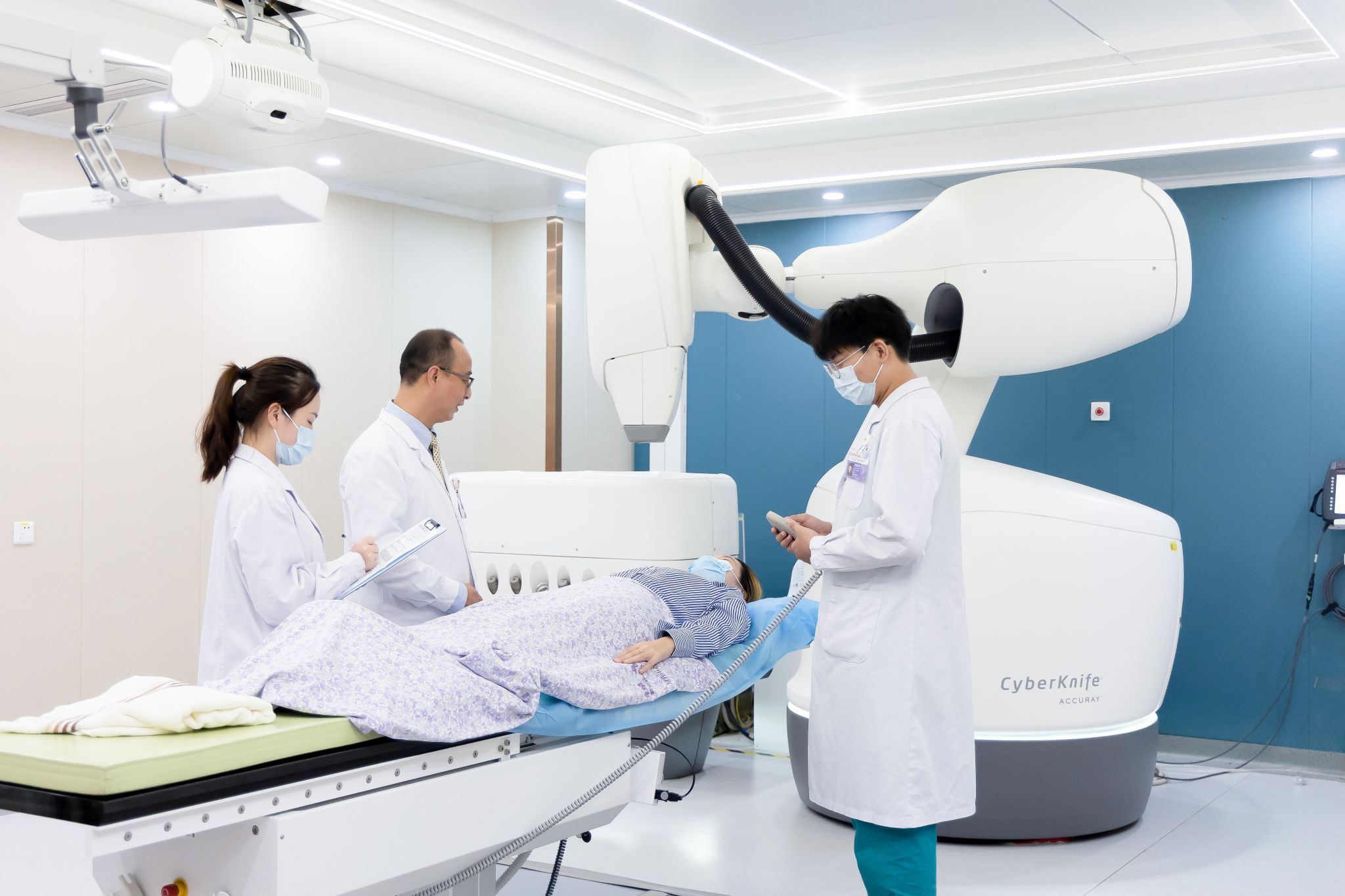
The CyberKnife M6 is the world’s only robotic radiosurgery system for tumors, representing a sixth-generation stereotactic body radiation therapy (SBRT) platform. Developed in the United States, the Foshan CyberKnife Center (founded by Dr. Yang Jun, a key contributor to North American CyberKnife quality control standards) is the first facility in Southern China to adopt this technology. Its core features include:
Non-invasive Treatment: Eliminates tumors with high-energy radiation—no surgery, bleeding, or anesthesia required.
Robotic Delivery System: Features a 6-dimensional robotic arm enabling 360° omnidirectional irradiation, selecting optimal paths from over 3,000 beam angles.
Clinically Validated: Recommended by the NCCN Guidelines and Primary Lung Cancer Diagnosis and Treatment Guidelines as a surgical alternative for select tumors.
Safe and Effective: The system is designed to minimize the risk of complications and side effects, including bleeding, infection, and other adverse events.
2. What Are the Advantages of CyberKnife?
Based on clinical data and literature (e.g., 2022 Best Paper of the International Society of Radiosurgery), its advantages include:
Ultrahigh Precision
→ 0.1 mm mechanical accuracy (vs. 1–5 mm for conventional radiotherapy), with errors smaller than a hair’s diameter.
→ Employs 5 real-time tracking technologies (e.g., fiducial tracking, 6D Skull Tracking™) to dynamically compensate for motion caused by breathing and organ movement.
Enhanced Safety & Efficiency
→ Treatment completed in merely 1–5 sessions (vs. 20–40 sessions for conventional radiotherapy), each lasting 15–30 minutes on an outpatient basis.
→ Protects healthy tissue: AI-powered quality control systems (e.g., InCise™ MLC collimator) reduce side effects, significantly lowering risks like urinary incontinence after prostate cancer therapy.
Clinically Validated Efficacy
→ High local control rates: 64% 5-year survival for early-stage liver cancer (per 2018 NCCN Guidelines); lung cancer SBRT outcomes surpass surgery (as demonstrated in medical literature).
→ Broad indications: Suitable for surgically challenging, recurrent, or elderly patients.
3. CyberKnife vs Conventional Radiotherapy
| Comparison Metrics | CyberKnife M6(Latest Edition) | Conventional Radiotherapy (e.g. IMRT/Gamma Knife) |
Treatment Precision | 0.1mm mechanical accuracy (thinner than hair diameter) | 1-5mm precision |
Session Count | 1-5 sessions (high dose per fraction, e.g. 45Gy/3 fractions for lung cancer) | 20-40 sessions (low dose per fraction, e.g. 2Gy/fraction) |
Indication Scope | Whole-body tumors (including mobile organs like spine/pancreas) | Primarily static tumors (e.g. brain tumors) |
Patient Experience | Non-invasive, no anesthesia, outpatient procedure | Requires fiducial markers/head frame fixation, some hospitalization |
Clinical Outcomes | Improved 5-year survival rates (64% vs 40% for liver cancer) | Lower local control rates (50-60% for lung cancer) |
Side Effect Control | 30% reduced dose to normal tissues (AI-powered organ avoidance) | Higher risks of radiation pneumonitis/enteritis |
Treatment Duration | 15-30 minutes per session | 30-45 minutes per session |
Guideline Status | NCCN-recommended (1st-line for early lung/prostate cancer) | Recommended as adjuvant therapy only |
4. How Does CyberKnife Work?
The workflow is based on "image guidance + dynamic adaptation" technology:
Targeting Phase
→ Tumor localization via CT/MRI/PET-CT imaging with 3D reconstruction (submillimeter precision).
→ Tracking method selection by tumor type (e.g., fiducial tracking for lung, 6D Skull Tracking™ for brain).
Treatment Phase
→ Real-time image guidance: Automatic tumor position verification every 10 seconds with robotic arm adjusting beam angles.
→ Adaptive irradiation: Automatically tracks tumor movement trajectories (e.g., respiration-induced shifts) to maintain precise focus.
Core Technologies
→ 6D robotic arm: 360° spherical irradiation to avoid critical structures (e.g., neural zones during brain tumor therapy).
→ AI quality control system: Optimizes dose distribution and reduces treatment time.
Case Evidence
→ Prostate cancer patient (68 years) received 5 fractions (total dose 36.25 Gy), achieving post-treatment PSA of 0.1 ng/mL without complications.
→ Lung cancer patient (53 years) treated with fiducial tracking: tumor fibrosis observed after 45 Gy in 3 fractions.
5. Who is Suitable for CyberKnife?
Solid Tumor Patients
→ Cranial Tumors: Brain metastases, arteriovenous malformations, trigeminal neuralgia.
→ Body Tumors:
- Lung cancer (early-stage/peripheral/central)
- Liver cancer (unresectable HCC, alternative to RFA)
- Pancreatic cancer (80% inoperable cases, combined with chemotherapy)
- Prostate cancer (for sexual function preservation; 93% report no life impact)
Special Populations
→ Elderly patients refusing surgery/anesthesia (e.g., Warren Buffett’s prostate cancer treatment).
→ Tumors adjacent to critical organs (e.g., spinal tumors, adrenal tumors).

6.Authority-Validated Evidence
→ Global Recognition: Certified by the Radiosurgical Society (RSS); center’s study awarded "Best Clinical Paper" at 2022 RSS Annual Meeting.
→ Notable Cases: Steve Jobs (pancreatic cancer), Warren Buffett (prostate cancer) utilized CyberKnife for survival extension.





 微信公众号
微信公众号